Practical, dignified home modifications that let you or your loved ones stay in the home you love — safely and comfortably — without moving to assisted living. From a Magnolia contractor who's helped dozens of local families age in place.
Quick Answer
Aging-in-place remodeling means modifying your home so you can live there safely through every stage of life — without stairs becoming hazards, bathrooms becoming dangerous, or daily tasks becoming struggles. The most impactful upgrades are zero-threshold showers, wider doorways, lever-handle doors, non-slip flooring, and a main-floor bedroom. In Magnolia and throughout Montgomery County, these modifications typically cost $15,000–$60,000 depending on scope — far less than even one year of assisted living.
Let's start with something most articles won't tell you: the cost of assisted living in the Greater Houston area now averages $4,500–$6,500 per month. That's $54,000–$78,000 per year. Even a substantial aging-in-place remodel — a fully accessible bathroom, a main-floor bedroom suite, widened doorways, and a no-step entry — costs less than one year of facility care. And you get to stay in the home you know, in the neighborhood you love, near the people who matter.
In Magnolia and the surrounding Montgomery County communities, we're seeing more families choose this path. The Woodlands, Tomball, Conroe, and Pinehurst are all home to retirees and multi-generational households who want to stay put. These aren't institutional modifications — they're thoughtful, attractive upgrades that make a home work better for everyone, regardless of age.
I've walked through homes where a 78-year-old homeowner was terrified of her own shower, where a couple had stopped using their beautiful second story because the stairs were too much, and where a family was considering selling because their aging parents couldn't navigate the front entry. None of them needed to move. They needed their homes to adapt — and that's exactly what we do.
The bathroom is where most aging-in-place remodels start — and for good reason. According to the CDC, more than 235,000 Americans visit the emergency room each year because of bathroom injuries. For adults 65 and older, it's the most dangerous room in the house. A wet floor combined with stepping over a tub wall is a recipe for disaster.
This is the single best aging-in-place upgrade you can make. A curbless shower has no lip or threshold to step over — the floor flows seamlessly from the bathroom into the shower area. For someone using a walker, cane, or wheelchair, this eliminates the most dangerous maneuver in the house. For everyone else, it's just easier, cleaner, and more modern-looking.
A curbless shower requires the floor to be sloped properly toward the drain — typically a 2% grade. In older Magnolia homes with concrete slab foundations, we can cut into the slab and recess the shower pan. In pier-and-beam homes (common in older parts of Montgomery and Conroe), the plumbing access from below makes this even more straightforward. Plan on $6,000–$12,000 for a curbless shower with tile, glass enclosure, grab bars, and a built-in bench.
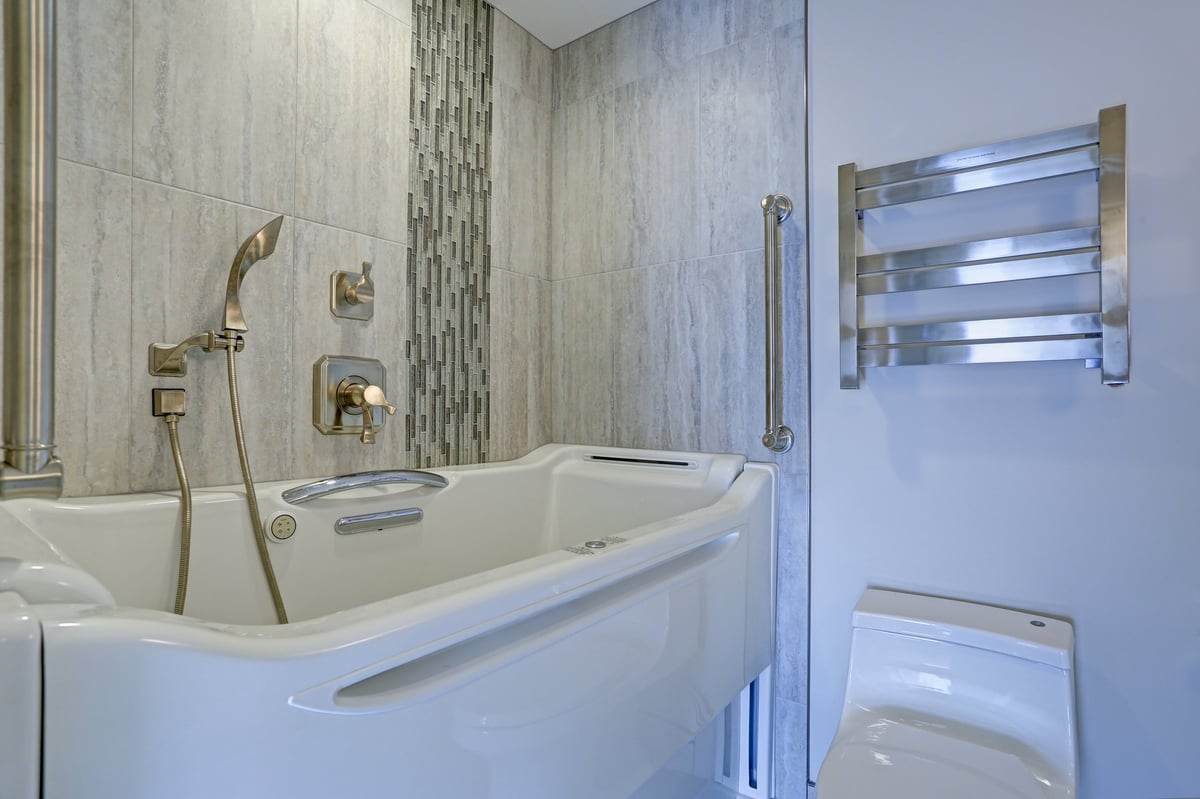
The days of institutional chrome grab bars are over. Today's grab bars come in brushed nickel, oil-rubbed bronze, and matte black — they look like premium towel bars and shower fixtures. We install them in three key locations: vertical at the shower entrance, horizontal along the back shower wall, and angled near the toilet. Behind the wall, we install solid blocking (plywood between the studs) so the grab bars are anchored into something structural — not just drywall anchors.
If your walls are open during a bathroom remodel in Magnolia, adding blocking for grab bars costs about $50 in materials and 30 minutes of labor. If the walls are finished, it's still doable but expect $200–$400 per bar for installation. The blocking is the important part — grab bars anchored only into drywall can pull out, which is worse than having no grab bar at all.
Standard toilets sit about 15 inches from floor to seat. Comfort-height (ADA-compliant) toilets are 17–19 inches — that 2–4 inch difference makes it dramatically easier to sit down and stand up, especially for anyone with knee or hip issues. We recommend the Toto Drake II or Kohler Highline — both are reliable, affordable (~$350–$500), and available in elongated bowl styles that look residential, not commercial.
For flooring, porcelain tile with a COF (coefficient of friction) rating of 0.42 or higher provides wet traction without looking like sandpaper. Avoid polished marble or glossy ceramic — they're dangerously slick when wet. We recommend 12"×24" matte-finish porcelain tiles with a slight texture. For the shower floor, smaller 2"×2" mosaic tiles create more grout lines, which provides natural slip resistance.
The kitchen presents different challenges: bending to reach lower cabinets, stretching for upper shelves, navigating tight spaces with a walker, and gripping small knobs with arthritic hands. None of these require a complete kitchen gut — targeted modifications make a huge difference.
Upper cabinets become increasingly difficult to use with age. Pull-down shelving systems (like Rev-A-Shelf's pull-down units) bring upper cabinet contents down to counter height with a gentle pull. Lower cabinets become accessible with full-extension roll-out drawers — no more kneeling and digging in the back of a dark cabinet. For a typical 10'×12' kitchen in a Magnolia home, retrofitting all lower cabinets with roll-outs costs $1,200–$2,000.
Small details matter enormously. Replace cabinet knobs with D-shaped pulls — they're easier to grip with arthritic fingers. Kitchen faucets should be single-lever (not two-handle) or touch-operated. The Delta Touch2O and Moen MotionSense faucets turn on with a tap anywhere on the spout — no gripping, twisting, or pulling required. These fixtures cost $250–$600 and take a plumber about an hour to install.
Standard countertops are 36 inches high — fine for standing, but unusable from a seated position. If you're doing a full kitchen remodel, include at least one section of counter at 30–34 inches with open knee space underneath (no cabinets). This lets someone prep food while seated. A pull-out cutting board at this station adds even more function. In homes where one spouse uses a wheelchair or has limited standing tolerance, this single change transforms the kitchen.
I've met too many Magnolia homeowners who haven't used their front door in years because of the steps. They come and go through the garage — which usually means navigating clutter, poor lighting, and a step up from the garage floor into the house. That's no way to live.
At minimum, one entrance to your home should be zero-step. For most ranch-style homes in Montgomery County, the easiest solution is a gently sloped concrete ramp (1:12 ratio — one foot of ramp length for every inch of rise) with a non-slip surface, handrails on both sides, and a small landing at the top. A 24-inch rise needs a 24-foot ramp, which is substantial. If space is tight, a vertical platform lift is an option, though it adds $5,000–$10,000.
For interior doorways, the minimum width for wheelchair and walker access is 32 inches clear (meaning the door itself is at least 34 inches). If you're in an older home in Conroe or Tomball with 28-inch or 30-inch doors, widening them to 36 inches makes a dramatic difference. During a remodel, widening a doorway costs $300–$600 per door. Retrofitting later costs $800–$1,500.
Two-story homes are popular in newer Magnolia subdivisions and throughout The Woodlands — but they're a long-term problem for aging in place. If you're already planning a major remodel, adding a main-floor bedroom suite (or converting an existing room like a formal dining room into one) is a forward-thinking move.
A main-floor suite should include: a bedroom large enough for a king bed with 36" of clearance on at least two sides, an accessible bathroom (curbless shower, comfort-height toilet, grab bars), a closet with lowered hanging rods, and easy access to the main living area and kitchen without stairs. Converting a 12'×12' spare room into a bedroom suite with an attached accessible bathroom typically runs $35,000–$55,000 in Magnolia, depending on whether plumbing lines are nearby.
If a main-floor suite isn't in the budget, consider whether your staircase can accommodate a stairlift. Most straight staircases in local homes can be fitted with a Bruno or Acorn stairlift for $3,000–$6,000. It's not ideal — but it keeps upstairs bedrooms accessible for far less than a full renovation.
Falls are the leading cause of injury among older adults, and flooring is a bigger factor than most people realize. Here's how common flooring types stack up for aging-in-place safety:
| Flooring Type | Slip Risk | Walker/Wheelchair | Fall Forgiveness | Cost per sq ft |
|---|---|---|---|---|
| Luxury Vinyl Plank | Low | Excellent | Good (slightly cushioned) | $3.50–$8.00 |
| Cork | Very Low | Good | Excellent (softest) | $5.00–$10.00 |
| Matte Porcelain Tile | Medium | Excellent | Poor (hard surface) | $5.00–$12.00 |
| Hardwood | Medium | Good | Poor (hard surface) | $7.00–$15.00 |
| Low-Pile Carpet | Low | Poor (resistance) | Good | $3.00–$7.00 |
Our recommendation: LVP throughout main living areas and hallways (durable, easy to clean, good traction), cork in the master bedroom (warm and forgiving underfoot), and matte-finish porcelain in bathrooms with non-slip mosaic tile in the shower. Avoid area rugs wherever possible — they're trip hazards. If you must have a rug, use a low-pile version with a non-slip pad and taped-down edges.
Older eyes need significantly more light — about 3–4 times more than younger eyes to see the same level of detail. Yet most homes are chronically underlit. This isn't just about comfort; it's about safety. A poorly lit hallway with a throw rug is a trip hazard. A dim stairway is an accident waiting to happen.
Rocker switches (the flat paddle style) are easier to operate than toggle switches for anyone with arthritis or reduced hand strength — and they cost the same. Motion-sensor switches in hallways, bathrooms, and closets mean nobody fumbles for a switch in the dark. We especially recommend them for the path between the bedroom and bathroom — a middle-of-the-night trip that's far more dangerous than most people realize.
Under-cabinet LED lighting in the kitchen eliminates shadows on the counter and makes food prep safer. Stair lighting — either recessed step lights or a continuous LED strip — makes stairs dramatically safer. These are all things your electrician can add during a remodel for $200–$500 per area. Well worth it.
Let's be transparent about costs. These are real numbers based on projects we've completed in Magnolia, Tomball, and throughout Montgomery County.
| Project | Scope | Typical Cost (Magnolia TX) |
|---|---|---|
| Accessible Bathroom | Curbless shower, grab bars, comfort toilet, non-slip tile, handheld showerhead, bench | $12,000–$22,000 |
| Doorway Widening | 5–8 doors widened to 36", new casing, paint | $3,000–$5,500 |
| No-Step Entry | Concrete ramp or regraded walkway, handrails, landing | $3,500–$8,000 |
| Kitchen Access Mods | Pull-down shelves, roll-out drawers, D-handles, lever faucet | $4,000–$8,000 |
| Main-Floor Suite | Bedroom + accessible bathroom conversion | $35,000–$55,000 |
| Stairlift | Straight staircase, installed | $3,000–$6,000 |
| Lighting Upgrade | Rocker switches, motion sensors, stair lights, under-cabinet LEDs | $2,000–$4,500 |
Prices reflect 2026 contractor rates for Magnolia and Montgomery County. Larger homes or complex floor plans may push costs higher. Permits add $200–$800 depending on scope. These are investments — they add lasting value to your home and your quality of life.
The most common call I get: "Mom fell in the shower last night. How soon can you fix this?" By then, it's reactive. The best time to make these modifications is while you or your loved one is still mobile and healthy. The modifications feel less like "giving in" and more like "planning ahead." Plus, you can take your time choosing finishes you actually like, rather than rushing to get something functional installed after an injury.
I've had clients in The Woodlands resist grab bars because they "don't want the bathroom to look like a hospital." I get it. But today's accessibility products are designed to blend in. A curbless shower with a linear drain, large-format tile, and a frameless glass enclosure looks like a luxury spa — not a medical facility. The grab bar in brushed nickel next to the matching towel bar and shower fixtures? Most people don't even notice it. Don't sacrifice safety for aesthetics when you can have both.
Door handles matter. Lever handles — not round knobs — are essential for anyone with arthritis or grip limitations. Rocker light switches beat toggle switches. A raised toilet seat with arms can be a temporary fix, but a proper comfort-height toilet with a nearby grab bar is a permanent solution. These small changes add up to a home that's genuinely easier to live in, and none of them are expensive.
If the primary entrance to your home is through the garage — common in Magnolia and most Texas suburbs — that entry needs to be accessible too. The step from the garage into the house, the door width, the lighting, and the path through the garage all matter. We've installed small ramps at garage entries for under $500 that made the difference between someone being able to come and go independently or needing help every time.
A good general contractor knows construction. A CAPS-certified contractor (Certified Aging-in-Place Specialist) understands the specific needs of older adults — things like optimal grab bar placement, proper ramp slopes, and how different disabilities require different solutions. If your contractor doesn't ask detailed questions about how you actually use your home and what specific challenges you face, find one who does.
We walk through your home with you — or with the family member who'll be living there — and identify every potential issue. Door widths, step heights, bathroom layouts, lighting levels, flooring transitions, cabinet accessibility. We bring a tape measure, a checklist, and a lot of questions about how you actually use each room.
We present a prioritized list of modifications with costs, timeline, and disruption estimates. Not everything has to happen at once. We'll help you figure out what's urgent, what can wait, and how to phase the work to minimize disruption — especially important if you're living in the home during construction.
Most aging-in-place modifications in Montgomery County require permits — especially bathroom remodels involving plumbing changes, doorway widening that involves structural walls, and any electrical work. We handle all permitting. Magnolia city limits, The Woodlands township, and unincorporated county areas all have slightly different requirements; we know them all.
A bathroom remodel: 2–4 weeks. Doorway widening and flooring: 1–2 weeks. A full main-floor suite addition: 6–10 weeks. We work one area at a time to keep at least one bathroom functional and minimize the impact on daily life. Our crews are trained to keep the workspace clean, respect your privacy, and communicate clearly throughout the project.
This isn't a typical remodel. The stakes are higher, the details matter more, and the relationship with your contractor needs to be built on trust and clear communication. Here's what to look for:
Aging in place isn't about preparing for decline — it's about maintaining independence, dignity, and quality of life. The home you've lived in for 20 or 30 years shouldn't force you out because the bathroom is unsafe or the stairs are too much. A thoughtful remodel can add decades of safe, comfortable living to your home — for far less than the cost of assisted living.
In Magnolia, Tomball, The Woodlands, Conroe, Pinehurst, and across Montgomery County, we've helped families make these changes with respect for their homes, their budgets, and their peace of mind. If you're thinking about aging-in-place modifications — for yourself or for a family member — let's talk. We'll walk through your home together and show you what's possible.
Whether you're planning ahead or need modifications now, Burton Residential Services can walk through your Magnolia-area home and show you exactly what's possible — with real recommendations, transparent pricing, and zero pressure. We serve Magnolia, The Woodlands, Tomball, Montgomery, Conroe, Pinehurst, and throughout Montgomery County.
Licensed & Insured • Serving Greater North Houston • Family-Owned