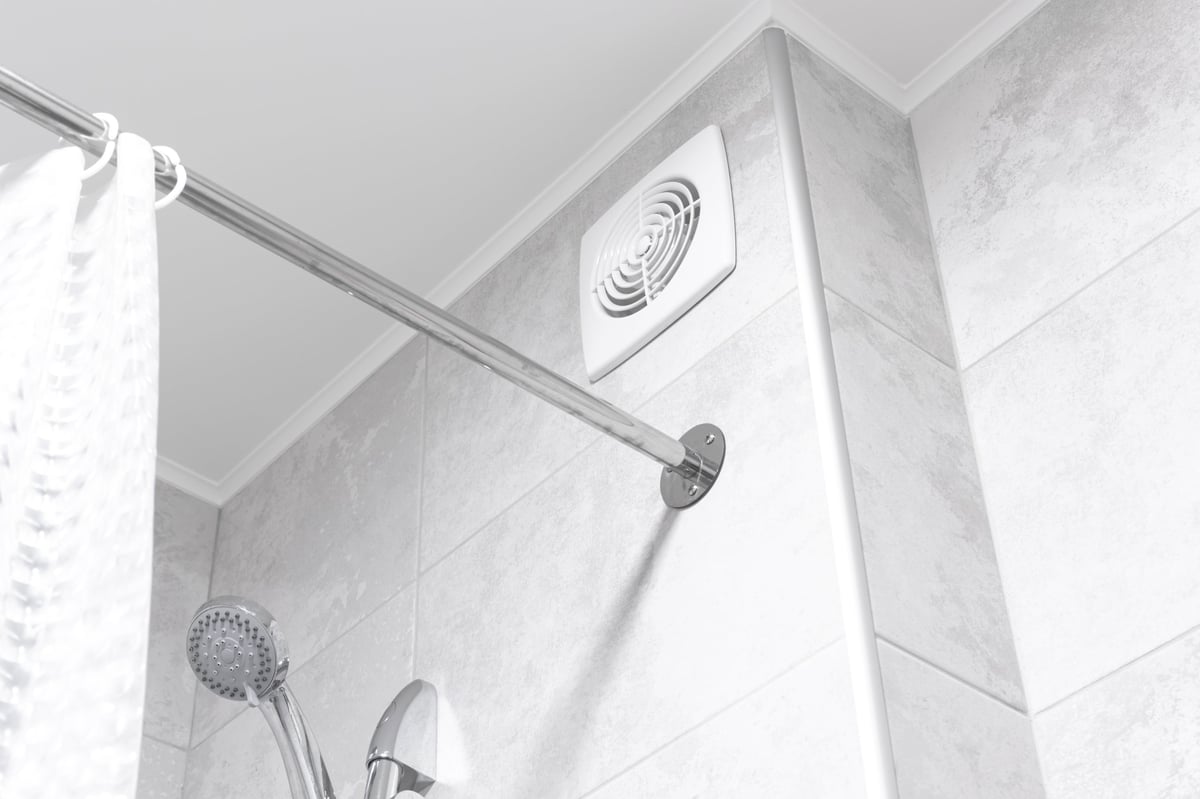
A bathroom exhaust fan does more than remove odors. It controls moisture that can damage paint, drywall, trim, grout, and cabinetry. In humid areas such as Houston, The Woodlands, Conroe, Montgomery, Magnolia, and Willis, proper ventilation is an essential part of protecting your home.
If your bathroom needs more than a fan replacement, Burton Residential Services also provides complete bathroom remodeling services. We can coordinate ventilation with tile, shower, electrical, painting, and other improvements instead of treating each issue separately.
1. Signs Your Bathroom Exhaust Fan Is Failing
A failing fan does not always stop working completely. Watch for these warning signs:
New or increasing noise
Grinding, rattling, buzzing, or squealing can indicate a worn motor or loose housing.
Weak suction
Hold a square of toilet paper near the grille. If the fan cannot hold it in place, airflow may be inadequate.
Moisture on mirrors
A mirror that stays fogged long after a shower suggests the fan is not removing humidity effectively.
Peeling paint or swollen trim
Persistent moisture can cause paint to blister and wood products to deteriorate.
Mold at grout lines
Recurring dark spots around the shower or ceiling may indicate that humid air is not leaving the room.
Cleaning the grille can improve airflow when dust is the problem. However, cleaning will not fix a failing motor, undersized fan, blocked duct, or improper vent route. If you are already planning a bathroom renovation, it is smart to inspect the ventilation system before walls and ceilings are closed.
2. How to Choose the Correct CFM
CFM means cubic feet per minute. It describes how much air the fan can move. For most bathrooms up to approximately 100 square feet, a practical starting point is about 1 CFM per square foot. For example:
60
CFM
60 sq ft bathroom
80
CFM
80 sq ft bathroom
100
CFM
100 sq ft bathroom
For a typical full bathroom, a fan in the 70–80 CFM range is often a reasonable choice. Larger bathrooms, rooms with high ceilings, separate toilet areas, or bathrooms with a jetted tub may require 100–150 CFM or more.
Do not automatically choose the largest fan available. Oversizing can increase noise and may not solve a poorly designed duct problem. The correct selection depends on room size, ceiling height, duct length, bends, and the fan manufacturer's specifications.
3. Non-Negotiable: Vent the Duct Outdoors
Bathroom exhaust air must travel all the way outdoors through a properly sized duct. Never vent a bathroom fan into the attic, insulation, or ceiling cavity. Dumping moist air into the attic can contribute to:
A professional installation should use an appropriate duct route to an exterior wall, roof cap, or approved exterior termination. The duct should be as short and straight as practical, with a backdraft damper and sealed connections. Long runs, excessive bends, or undersized ducting can make even a powerful fan perform poorly.
The Building America bathroom exhaust guidance and ENERGY STAR ventilation-fan criteria provide useful benchmarks for outdoor venting, airflow, efficiency, and sound.