
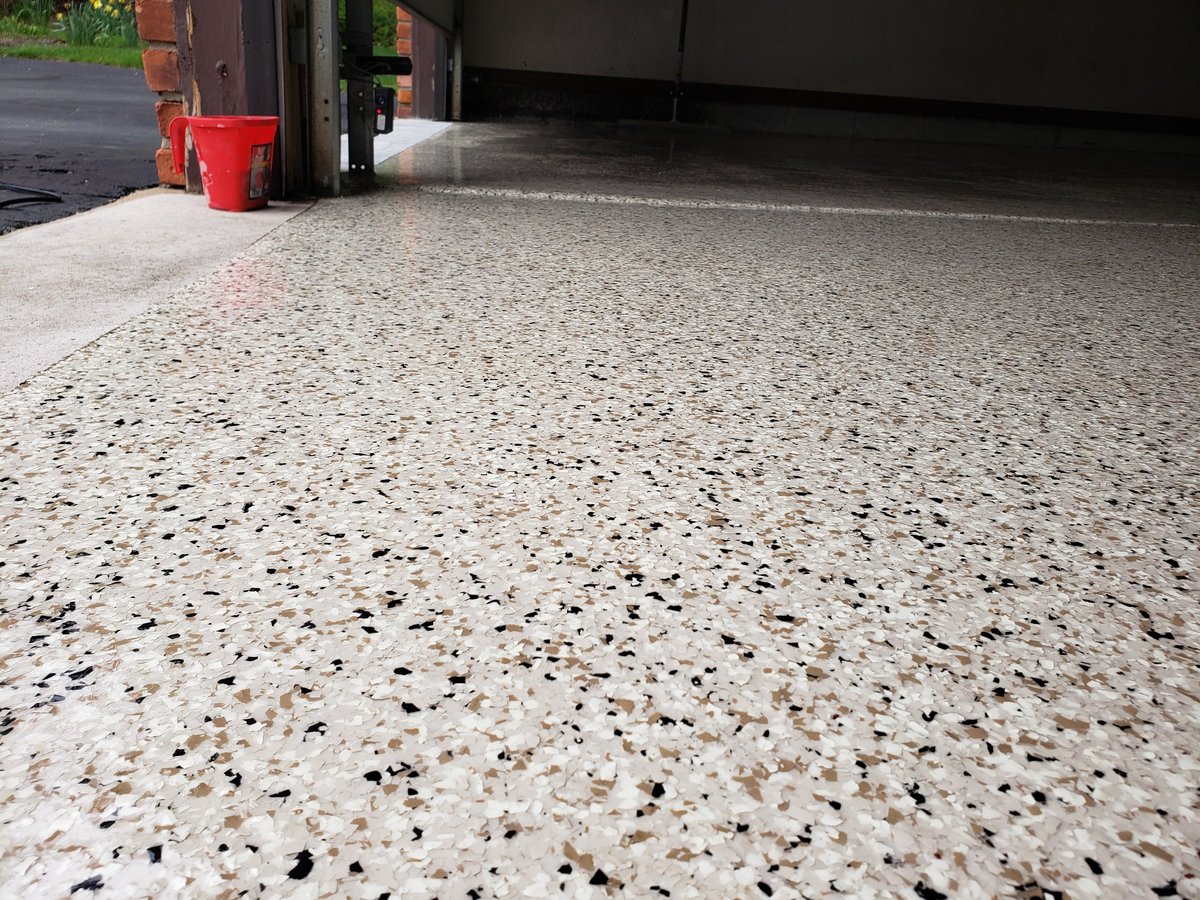
A coated garage floor can make your space easier to clean and more useful, but the right choice depends on your concrete, sunlight, daily traffic, and budget.
If you’re comparing options beyond a basic epoxy floor, start with this guide and our earlier Houston garage epoxy coating guide. For help planning related flooring or home updates, see our home services. We serve homeowners in The Woodlands, Conroe, Montgomery, Magnolia, Willis, and surrounding communities.
1. Why Houston Garage Floors Need the Right System
Concrete is porous. Moisture vapor can move through a slab, and conditions under and around a home (including local soil, drainage, and the slab’s moisture protection) can affect how much moisture reaches the surface. Houston-area humidity and weather make it especially important to evaluate the actual slab rather than assume it is ready for coating.
Other common stressors include hot tires, oil and road grime, and sunlight entering through an open garage door. Hot tires can lift a poorly bonded or thin coating. Standard epoxy can yellow with UV exposure. And if moisture pressure is not addressed, even a premium coating may blister, peel, or separate from the concrete.
Non-negotiable: surface preparation and moisture assessment determine whether a coating can bond and last. A coating label cannot compensate for a slab that has not been properly checked and prepared.
2. Coating Options Compared
| Option | Strengths | Watch For |
|---|---|---|
| Floor Paint (Acrylic / Latex) | Lowest initial cost, simplest to apply | Shortest service life in a working garage — often only a few years |
| Epoxy | Hard, durable, well-suited to prepared slabs | Can yellow under UV; longer recoat and cure times |
| Polyaspartic | Faster return to service, better sunlight resistance | Shorter application window; still requires full prep |
| Polyurea | Related resin technology with fast-cure systems | Products vary widely — check the full system specification |
These are broad planning estimates, not guarantees. Traffic, slab condition, maintenance, product specifications, and installation quality affect actual results. Flake and quartz are decorative aggregates broadcast into a coating; they are not stand-alone coatings.
Polyaspartic and polyurea systems are related resin technologies, and products vary. Ask what the system includes (primer, basecoat, broadcast, and topcoat) and request the product’s installation and cure requirements.
3. What Professional Preparation Includes
A professional coating job is more than rolling resin onto concrete. The scope should explain what happens before the coating goes down.
Concrete inspection and moisture testing
The installer checks the slab and uses an appropriate test method. Results should be considered against the coating manufacturer’s limits.
Mechanical grinding
Diamond grinding removes weak surface material and creates a profile for bonding. Acid etching alone may not produce consistent preparation, especially where the slab has sealers, contaminants, or uneven areas.
Crack and divot repair
Cracks and damaged areas need compatible repair materials. Active or moving cracks may reappear; a coating is not a structural repair.
Perimeter details
Stem walls and cove base, the short vertical transition where floor meets wall, should be included in the written scope if you want them coated.
Compatible coating layers
The primer, basecoat, flakes or quartz, and topcoat must work together. A UV-resistant topcoat can help protect the finish in garages exposed to sunlight.
Ask whether the estimate includes grinding, repairs, moisture mitigation if needed, and cleanup. A low price that omits these steps may not be an equivalent comparison.
4. Houston Heat, Sunlight, and Slip Resistance
Texas heat can narrow the application window. Concrete temperature, air temperature, humidity, and dew point all matter, and each product has its own limits. Epoxy generally needs more time between coats and before vehicle traffic. Fast-cure systems can be useful when weather and scheduling are challenging, but they also give installers less time to apply and finish the material. Follow the system’s technical instructions rather than relying on a generic cure-time promise.
Sunlight through an open garage door can discolor standard epoxy over time. If the floor gets regular UV exposure, ask about a UV-stable topcoat or a system designed for that exposure.
A smooth, glossy floor may become slippery when wet. Flake or quartz broadcast can add surface texture, but it does not guarantee traction. Ask about an appropriate anti-slip additive and review a sample under realistic conditions, especially if rainwater commonly enters your garage.
5. 2026 Garage Floor Coating Costs
These broad Houston-area ranges are for planning. Your garage size, concrete condition, repairs, chosen system, and perimeter work affect the final estimate.
| Cost Factor | Effect on the Estimate |
|---|---|
| Coating system | Paint → epoxy → polyaspartic / polyurea, generally increasing |
| Garage size | A 400–500 sq ft garage is the common two-car baseline |
| Slab condition and repairs | Cracks, divots, and moisture mitigation add scope |
| Decorative and perimeter work | Flake or quartz broadcast, stem walls, and cove base |
For a 400–500-square-foot garage, a DIY kit’s material cost can look attractive. But equipment, preparation supplies, repairs, and the risk of redoing a failed coating affect the real cost. Professional estimates should list preparation and add-ons clearly so you can compare the complete scope, not just the coating price.
6. Common Mistakes to Avoid
Skipping moisture testing
Moisture-related failure can happen under an attractive new finish.
Relying on acid etching alone
Etching may not remove contaminants or create the required surface profile.
Coating over active cracks or damage
Repair and assess the concrete first; a coating will not stop slab movement.
Ignoring the topcoat
The final layer affects UV resistance, abrasion performance, and how the floor feels underfoot.
Choosing by cure speed alone
A fast return to vehicle use is useful, but it does not replace proper preparation or careful application.
If you’re weighing garage floor epoxy vs polyaspartic cost, compare the complete system, stated lifespan, UV exposure, warranty terms, and preparation plan. The right choice is the one suited to your slab and how you use the garage, not simply the fastest or cheapest option.