
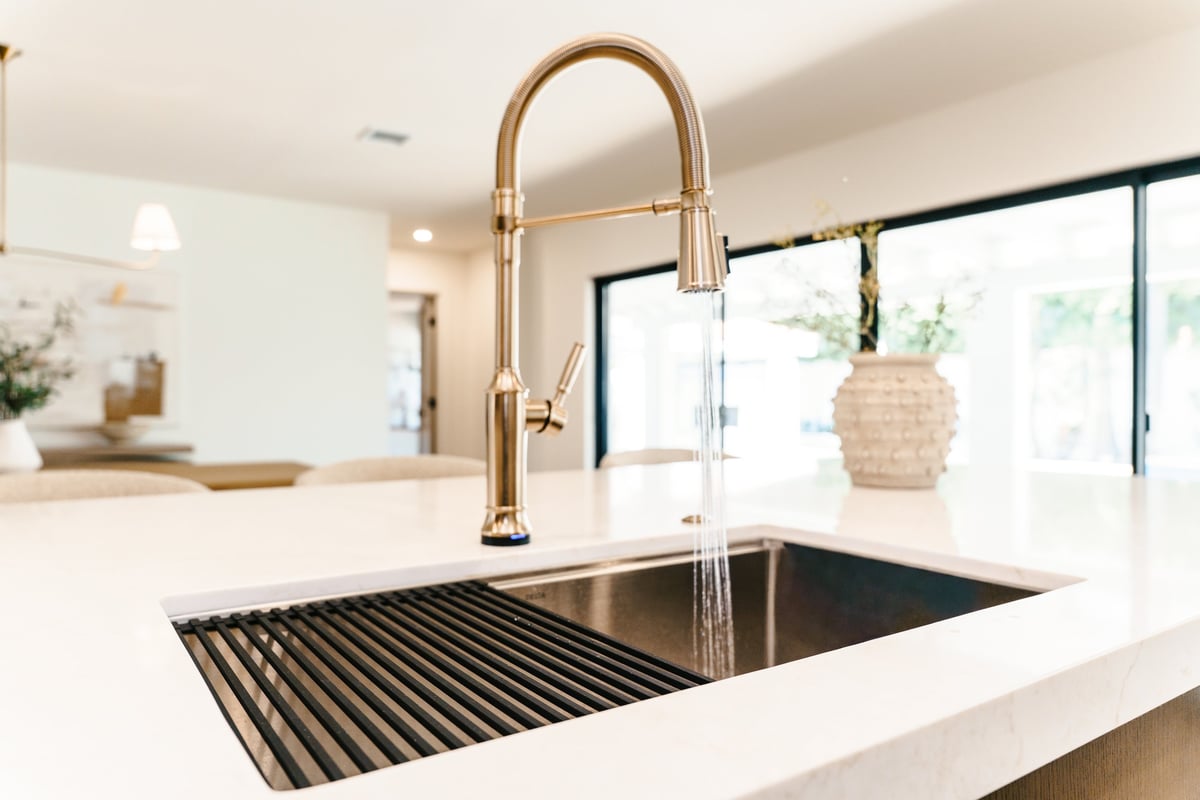
A sink replacement can be a straightforward fixture upgrade, or a project involving countertop fabrication, cabinet changes, and plumbing adjustments.
If you’re planning a larger update, explore our kitchen remodeling services. For sink connections, drains, and disposal compatibility, see our plumbing services.
For homeowners in The Woodlands, Conroe, Montgomery, Magnolia, Willis, and greater Houston, the right sink depends on your countertop, sink base cabinet, daily routine, and budget. Measure and confirm those details before you buy. A sink that looks right in a showroom still needs to fit the opening and plumbing under your counter.
1. Compare Sink Styles
Drop-In (Top-Mount)
The rim rests on top of the counter and covers the cut edge. Often the simplest replacement when your new sink matches the existing opening. Works with a wider range of countertops, including laminate.
Undermount
The sink attaches beneath the countertop, creating a clean edge you can wipe crumbs into. Typically suited to granite, quartz, or solid surface — not laminate. The cut edge is exposed and must be properly finished.
Farmhouse / Apron-Front
The exposed front panel gives a distinctive look, but installation can require modifying the cabinet face and adding support. Confirm dimensions and cabinet requirements before ordering.
Workstation
Integrated ledges hold accessories such as cutting boards, drying racks, or colanders. Check that accessories fit your cooking habits and that the faucet and sink fit together.
2. Choose a Bowl Configuration That Suits Your Routine
A large single bowl can make it easier to wash roasting pans, stockpots, and baking sheets. A double bowl lets you separate tasks, such as rinsing produce and soaking dishes, but each basin is smaller.
Before you choose, compare the bowl’s interior dimensions with your largest pan. Check its depth, too: a deeper bowl can reduce splashing, but may leave less room for a garbage disposal and drain connection beneath it.
3. Sink Materials at a Glance
Sink prices vary by size, finish, brand, and included accessories. Compare construction quality and warranty alongside price.
| Material | Strengths | Considerations |
|---|---|---|
| Stainless Steel | Durable, forgiving, works with every style | Compare gauge and sound insulation |
| Fireclay | Resists chips, scratches, heat | Heavy — needs a support plan; farmhouse-friendly |
| Cast Iron | Classic enamel, very durable | Very heavy; needs cabinet reinforcement |
| Composite / Granite Composite | Heat and impact resistant, many colors | Follow the manufacturer’s cleaning guidance |
Stainless Steel: 16 Gauge or 18 Gauge?
Gauge refers to the thickness of the steel; a lower gauge number means thicker steel. A 16-gauge sink is thicker than an 18-gauge sink and may feel sturdier and resist denting better. An 18-gauge option may cost less. Compare the product specifications, sound insulation, and warranty rather than choosing on price alone.
4. Cabinet and Countertop Checks Come First
Measure the sink base cabinet’s inside width, depth, and usable height. Don’t rely only on the cabinet’s outside measurement. The sink maker’s specification sheet lists a minimum cabinet size; confirm it before purchasing. Also check the faucet location, cabinet framing, and available clearance below the bowl.
A new sink may require a different countertop opening. Granite and quartz cutouts should be handled by a countertop fabricator, who can use the sink template and finish the exposed edge. Laminate and solid-surface counters have different construction and finishing requirements, so confirm what’s possible with the countertop professional before work starts.
Never assume an existing opening can be enlarged or reused without inspection. The cutout’s size, shape, and position must suit the new sink and leave enough material around it.
Farmhouse sinks deserve extra planning. Their apron-front design may require changing the cabinet face, adjusting the countertop opening, and building support under the sink. Heavy fireclay or cast-iron models need a support plan, not just a bead of adhesive.
5. 2026 Houston-Area Replacement Cost Guide
These ranges are for early budgeting, not a guaranteed quote. Final costs depend on sink choice, access, countertop material, existing plumbing, and cabinet condition.
| Replacement Type | 2026 Planning Range |
|---|---|
| Like-for-like drop-in replacement | Lowest end of the range — same opening, same style |
| Undermount retrofit | ~$450–$1,400 |
| Farmhouse with cabinet modification | Highest end — cabinet work, countertop cutout, support |
Ask whether the estimate includes removing and hauling away the old sink, mounting hardware, drain basket, disposal connection, faucet reconnection, and countertop work. If plumbing must move or the disposal does not fit the new bowl depth, those may be separate costs.
6. Installation Details That Prevent Avoidable Problems
Check drain location and disposal clearance
A new bowl can put the drain lower or in a different position. Confirm that the disposal, trap, and wall drain can connect without forcing pipes into place.
Inspect mounting hardware
Old sink clips may be corroded, loose, or incompatible with a replacement. Undermount sinks need proper support and suitable mounting hardware; the sink’s weight must not rely on adhesive alone.
Replace worn drain parts when appropriate
A corroded basket strainer or damaged seal can leak even after a new sink is installed. Check the condition of the drain assembly while the old sink is out.
Coordinate sink selection with countertop templating
If you’re remodeling, choose the sink before the fabricator measures and cuts the counter. Changing sink dimensions after templating can mean extra fabrication, or a poor fit.
7. Common Mistakes to Avoid
Buying a sink without checking the sink base cabinet’s usable dimensions and depth.
Choosing thin, low-cost steel without comparing gauge, construction, and warranty.
Ordering a farmhouse sink before confirming cabinet modification and support needs.
Assuming a disposal will fit beneath a deeper bowl.
Scheduling countertop templating before selecting the sink and confirming its cutout specifications.
For a clean fit, coordinate sink, cabinet, countertop, and plumbing decisions before installation begins. That preparation is especially important when replacing a drop-in sink with an undermount or farmhouse model.