Under Cabinet Lighting Installation Houston | 2026 Costs
Home Blog Under Cabinet Lighting Houston 2026
Kitchen Lighting Guide 2026

Under Cabinet Lighting Installation in Houston: Types, Layout, and 2026 Costs

Compare under-cabinet lighting types, layouts, electrical requirements, and 2026 installation costs for Houston and Montgomery County kitchens.

By Gary Burton
October 11, 2026
10 min read
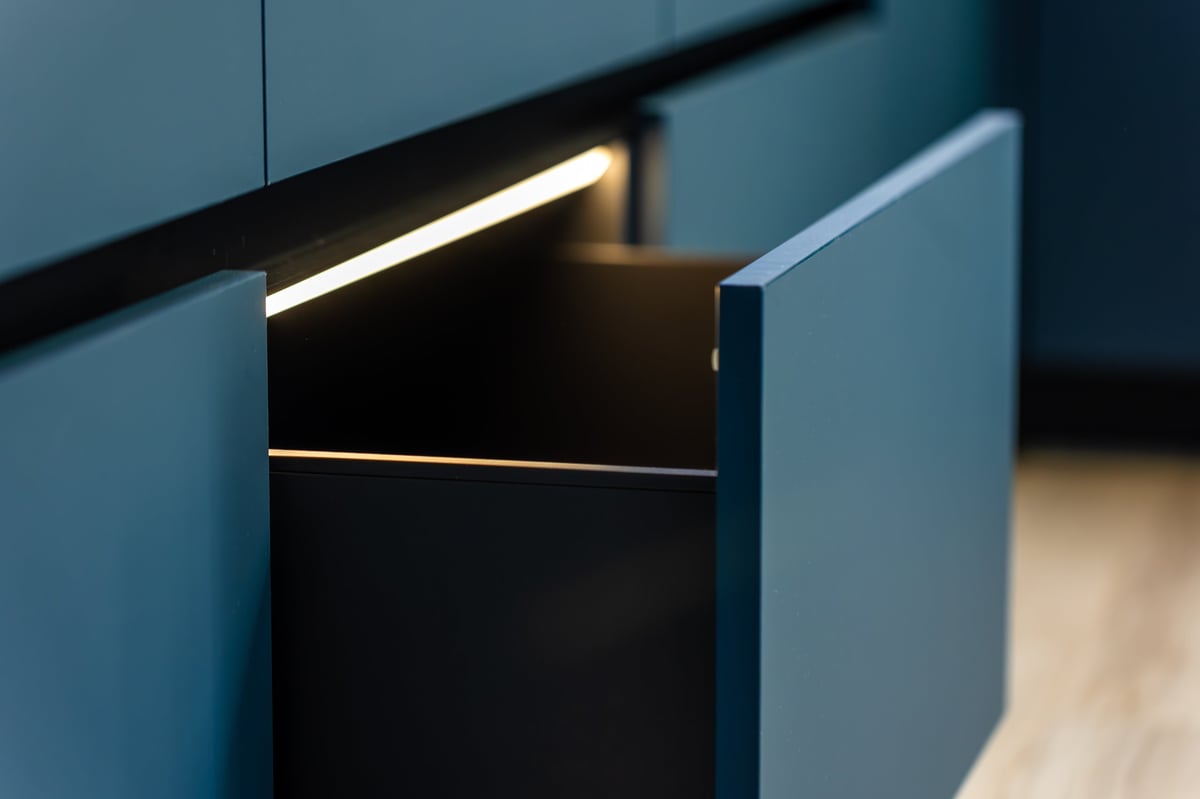
Close view of a handleless drawer lit by warm LED. Matte blue fronts and crisp lines deliver a clean, contemporary kitchen aesthetic.

A well-planned lighting upgrade can make your kitchen easier to use, more comfortable, and more polished without changing the entire room. If your countertop feels dim or your overhead fixtures create shadows while you prepare food, under-cabinet lighting may be the solution. Burton Residential Services helps homeowners plan complete kitchen remodeling projects, including cabinetry, electrical work, countertops, and task lighting.

For homeowners in The Woodlands, Conroe, Montgomery, Magnolia, and Willis, the right system depends on your cabinet layout, countertop depth, preferred appearance, and access to electrical power. This guide explains under cabinet lighting installation in Houston, including fixture types, task-lighting placement, color temperature, wiring options, and realistic 2026 prices.

1. Under-Cabinet Lighting Costs at a Glance

Your total price depends on whether the system is plug-in or hardwired, how many cabinet runs require lighting, and whether new wiring is needed. Typical 2026 planning ranges include:

System / Component 2026 Planning Range
LED tape or strip materials $15–$50 per run
LED puck light sets $20–$60 per set
Linear bar lights $25–$80 per fixture
Simple plug-in installation $150–$500
Hardwired installation $600–$2,000 for a typical kitchen
Complex projects $2,000–$3,500+

Complex projects reach $2,000–$3,500 or more when new circuits, multiple switches, concealed wiring, or cabinet modifications are required. These are planning ranges, not fixed quotes. Your final kitchen lighting cost in Montgomery County will depend on the condition of your existing electrical system and the number of cabinet sections being illuminated.

2. LED Tape vs. Puck vs. Linear Bar Lights

LED Tape or Strip Lighting

LED tape is a flexible strip containing closely spaced light-emitting diodes. It works well when you want a continuous line of light across a long cabinet run.

Best for:

  • Even task lighting across countertops
  • Long stretches of cabinets
  • Contemporary kitchens
  • Low-profile installations

For a finished appearance, tape lighting should be installed inside an aluminum channel with a diffuser. The channel protects the strip, helps manage heat, and softens individual bright spots. Adhesive-only installation may be less durable in Houston-area heat and humidity.

LED Puck Lights

Puck lights are small, round fixtures that create focused pools of light. They can work well over a coffee station, sink, decorative backsplash, or specific food preparation area.

Advantages include:

  • Simple point-by-point placement
  • Strong accent lighting
  • Useful for highlighting select countertop areas
  • Available in hardwired, plug-in, and battery versions

The warning is uneven coverage. Poorly spaced puck lights can create bright circles and dark gaps. They are often better for accent lighting than for full countertop task lighting.

Linear Bar Lights

Linear bar fixtures provide broad, consistent illumination and are available in several lengths. Multiple bars can often be connected beneath a longer cabinet run.

They are a practical choice when you want:

  • Clean, even coverage
  • A straightforward installation
  • Fewer visible hot spots
  • A fixture that is easier to replace than custom-cut tape

Linear bars are especially useful for kitchens with standard cabinet sections and a simple, uninterrupted layout.

3. Task Lighting Layout: Where Fixtures Should Go

The goal is to illuminate the working surface, not the wall behind it. In most kitchens, fixtures should be installed toward the front edge of the upper cabinets. This position reduces shadows caused by your body while chopping, mixing, or cleaning.

1

Front-of-cabinet placement

Place continuous strips or linear bars near the front of the cabinet underside.

2

Aim toward the counter

Direct light toward the countertop and backsplash — not the wall.

3

Hide the fixtures

Keep fixtures hidden behind the cabinet face or front rail when possible.

4

Continuous over long runs

Use continuous lighting for long runs to avoid dark areas.

5

Space puck lights evenly

Match spacing to their beam angle and cabinet length.

6

Test at night

Test the placement at night before permanently mounting fixtures.

7

Coordinate the zones

Coordinate lighting zones with your sink, range, island, and primary preparation areas.

If cabinets stop or change depth, treat each section as its own lighting run. This produces better control and prevents a single long strip from creating uneven brightness.

4. Color Temperature: Choose 2700K to 3000K

Color temperature is measured in Kelvin. It describes whether the light appears warm and yellow or cool and blue. For most residential kitchens, 2700K to 3000K is the best range. This warm-white light works well with wood cabinets, quartz countertops, natural stone, and common residential ceiling fixtures.

2700K

Warmer and more comfortable for traditional kitchens.

3000K

Slightly cleaner and more modern while remaining inviting.

3500K+

Crisper, but may look too cool beside warm ceiling lights.

Choose a dimmable, high-quality LED system with good color rendering. A high Color Rendering Index, or CRI, helps food, cabinetry, paint, and countertops appear closer to their natural colors.

5. Hardwired vs. Plug-In Lighting

Hardwired Systems

Hardwired lighting connects directly to your home's electrical system. It provides the cleanest appearance and can usually be controlled by a wall switch or dimmer.

Best when:

  • You are already remodeling the kitchen
  • You want hidden wiring
  • You want one switch to control all cabinet lights
  • You are installing multiple cabinet runs
  • You want a permanent, resale-friendly upgrade

Plug-In Systems

Plug-in systems connect to an existing receptacle. They are often less expensive and can work well when an outlet is already positioned inside or near the cabinets.

The drawback is cord management. Cords should never hang loosely across the backsplash, interfere with appliances, or rest near heat or water. If the wiring will be visible or requires drilling through cabinets, professional installation may still be worthwhile.

6. Electrical Requirements and Safety

Electrical work is non-negotiable when connecting new fixtures to household wiring. A hardwired system may require an approved junction box, a compatible driver or transformer, properly sized wiring, and a switch or dimmer rated for the fixture. Important considerations include:

  • Line-voltage fixtures connect to 120-volt household power.
  • Low-voltage LED systems require a compatible driver or transformer.
  • Drivers must remain accessible for future service.
  • Connections should be enclosed in approved electrical boxes.
  • Wiring must be protected from sharp cabinet edges.
  • Areas near sinks may require GFCI protection.
  • New circuits or significant wiring changes may require permits.

Hardwired work should be completed by a qualified electrical professional. Never bury an inaccessible transformer behind finished cabinetry. Never make exposed electrical connections inside a cabinet. If your kitchen is being remodeled, plan wiring before the backsplash, cabinets, or trim are installed.

7. What Affects Kitchen Lighting Cost in Montgomery County?

Homeowners in The Woodlands, Conroe, Montgomery, Magnolia, and Willis may see different prices based on the project's access and scope. Cost typically increases when:

  • Cabinets must be removed or modified.
  • Walls need to be opened for concealed wiring.
  • A new circuit or breaker is required.
  • Multiple switches or dimmers are installed.
  • The kitchen has several disconnected cabinet runs.
  • A transformer must be relocated.
  • Existing electrical work needs correction.
  • Permitting or inspections are required.

A simple plug-in upgrade may be completed for a few hundred dollars. A professionally designed hardwired system with three or four cabinet runs, a dimmer, concealed wiring, and quality LED fixtures commonly falls in the mid-hundreds to low-thousands.

Frequently Asked Questions

Ready to Improve Your Kitchen Lighting?

Ready to plan under-cabinet lighting that looks clean and works properly? Get a free, no-obligation estimate. We'll help you choose the right fixtures, layout, controls, and electrical approach for your kitchen. Serving Montgomery County for 40+ years.

Serving Montgomery County, The Woodlands, Conroe, Montgomery, Magnolia, Willis & Greater Houston