Houston-area homeowners often notice chlorine or chloramine taste, mineral spots on glassware, dry-feeling skin, and scale around faucets. Your exact water quality depends on your utility, neighborhood, and whether you receive city, MUD, or well water.
Before choosing equipment, review your provider's latest Houston water quality report and consider a professional assessment. A properly planned system can be part of a larger home repair and improvement project. Burton Residential Services can also coordinate the required plumbing work, including the main-line connection, drain routing, shutoff access, and finish repairs after installation.
1. What Houston-Area Water Filtration Systems Address
A whole house water filtration system in Houston is installed at the point of entry, meaning water is treated as it enters your home. This allows filtered water to reach showers, bathrooms, laundry fixtures, and faucets.
Common concerns include:
Chlorine or chloramine
Can affect taste and odor. The correct carbon media depends on the disinfectant used by your provider.
Hard water minerals
Calcium and magnesium can create spots, scale, and reduced efficiency in water heaters and fixtures.
Sediment
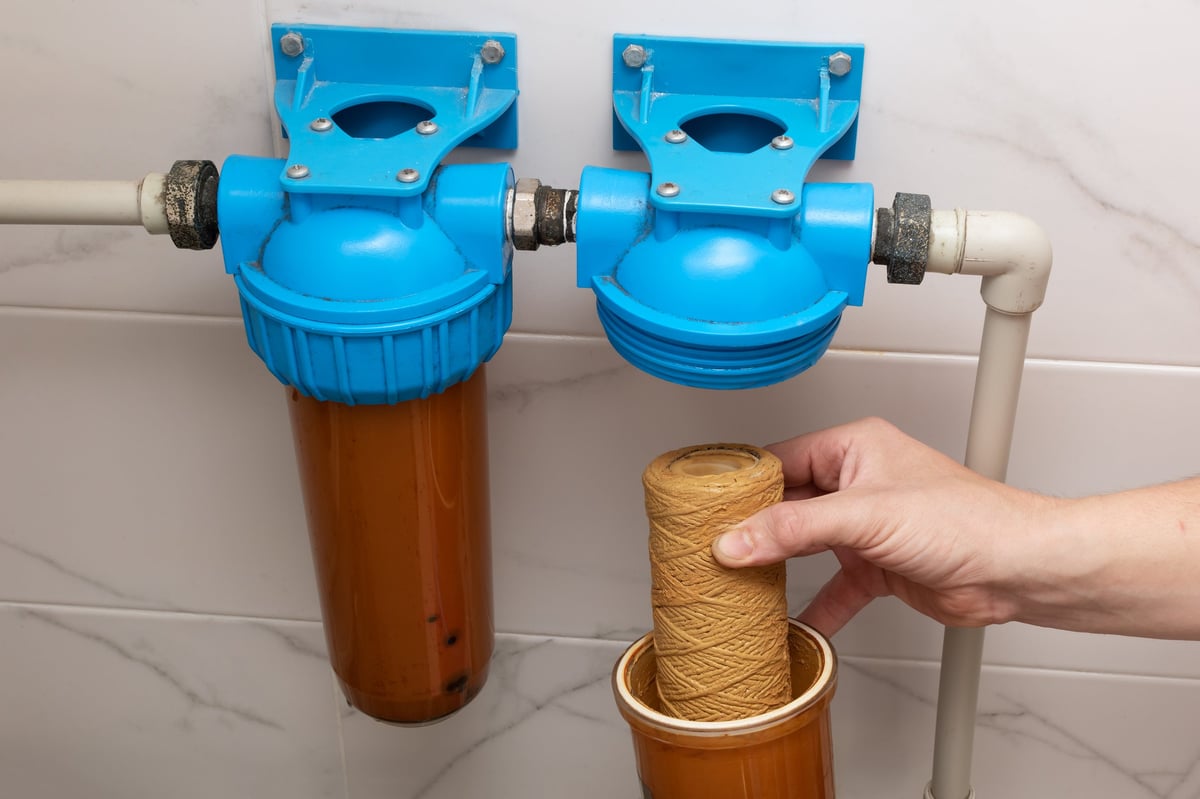
Sand, rust, or pipe debris may require a pre-filter.
Drinking-water purity
Some homeowners want additional treatment for cooking and drinking at one faucet.
A non-negotiable first step is identifying your actual water conditions. Do not size a system based only on a neighbor's equipment.
2. Carbon Filter vs. Water Softener vs. Reverse Osmosis
Whole-House Carbon Filtration
A carbon filter improves taste and odor throughout the house. Catalytic carbon is often considered when chloramine is present, while standard activated carbon may be appropriate for certain chlorine applications.
Best for:
- Improving shower and tap-water odor
- Reducing chlorine-related taste
- Treating water at every fixture
- Homeowners who do not need hardness reduction
A carbon system does not typically remove hardness minerals. It also requires periodic media replacement or servicing.
Water Softener
A salt-based water softener exchanges hardness minerals for sodium or potassium. It helps reduce scale, spotting, and mineral buildup but is not a substitute for carbon filtration.
Best for:
- Hard-water scale
- Mineral spots on fixtures
- Protecting plumbing and water-using appliances
- Improving soap performance
Salt-free conditioners may reduce scale in some applications, but they do not soften water in the traditional sense. Ask what the equipment is designed to accomplish before comparing prices.
Reverse Osmosis at the Kitchen Sink
Reverse osmosis, or RO, is a point-of-use system. It treats water at one faucet rather than supplying every fixture. An under-sink RO system is commonly used for drinking and cooking.
RO typically requires:
- A dedicated faucet
- A storage tank or tankless unit
- A drain connection
- Replacement pre-filters
- Periodic membrane replacement
For many Houston-area homes, the most practical combination is a whole-house carbon filter, a softener where hardness justifies it, and under-sink RO for drinking water.
3. How the Systems Work Together
A typical installation sequence is:
Sediment pre-filter, if needed
Whole-house carbon filtration
Water softener
Under-sink reverse osmosis system
The order can vary based on water testing, equipment specifications, and the home's plumbing layout. A professional should confirm flow rate and pressure so showers, appliances, and multiple fixtures still perform properly.