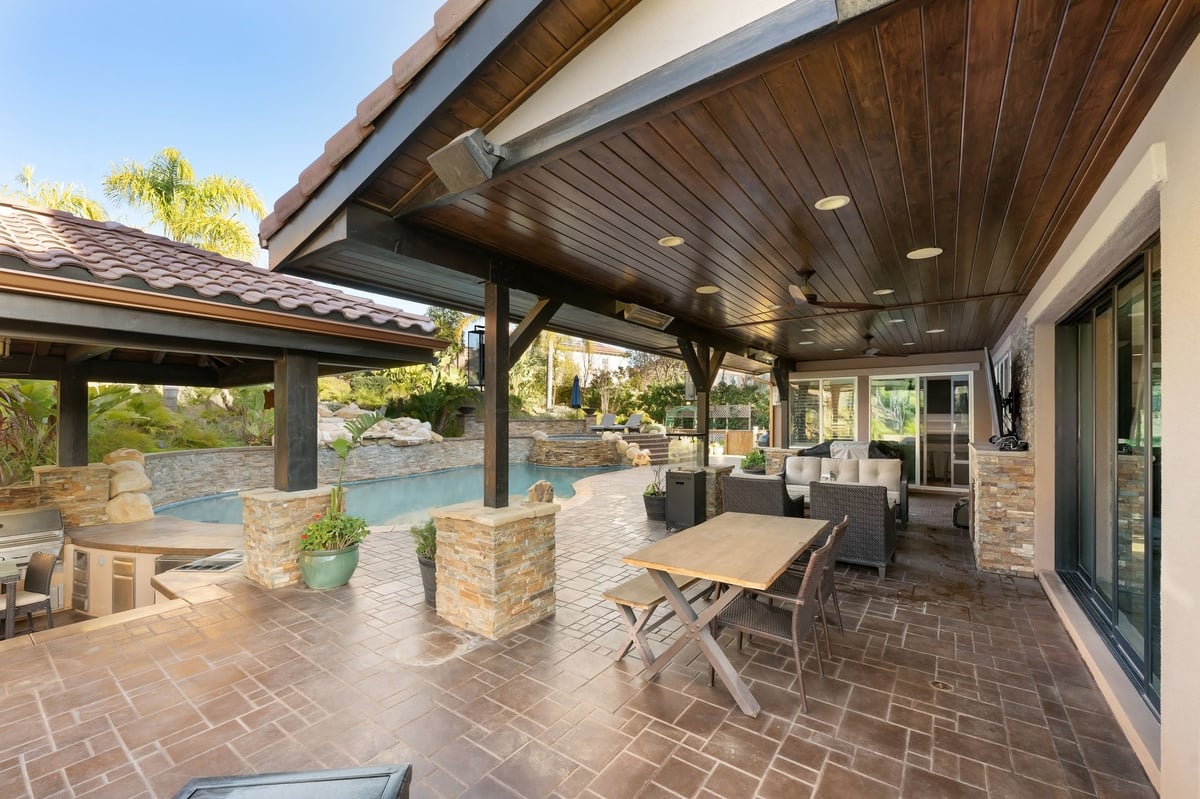
From covered patios and outdoor kitchens to fire pits and native landscaping — here's what Magnolia homeowners should build (and what to skip) to get the best return on investment while creating a backyard you'll actually use all year.
Quick Answer
The outdoor living projects that deliver the best ROI for Texas homes are covered patios (60–80% ROI), outdoor kitchens (55–75%), and native landscaping (up to 100%+ ROI). Projects to approach with caution include swimming pools (40–50% ROI) and elaborate water features. The key to maximizing return is building features that extend your usable living space through our long Texas spring and fall seasons — not just summer.
Here's something most home improvement articles miss: in Texas, your backyard isn't just a yard — it's bonus square footage for eight or nine months of the year. We're not in Minnesota where outdoor space is usable for three months. In Magnolia, Tomball, and throughout Montgomery County, we're grilling in March, eating outside in November, and gathered around the fire pit in January. When you build a well-designed outdoor living space, you're functionally adding square footage to your home. And appraisers and buyers both recognize that value.
The numbers back it up. According to the National Association of Realtors, a new patio returns 55–80% of its cost at resale, and outdoor kitchens return 55–75%. Some landscape upgrades — particularly mature native plantings and shade trees — can return over 100% when you factor in both property value increase and energy savings from reduced cooling loads. And here's the local angle: homes in The Woodlands and Magnolia with professionally designed outdoor spaces consistently sell faster and for more per square foot than comparable homes without them. The Texas lifestyle is an outdoor lifestyle, and buyers are willing to pay for it.
I've designed and built outdoor living spaces for dozens of Magnolia-area families — from simple covered patios to full outdoor kitchens with stone fireplaces. The projects that make people happiest aren't always the most expensive. They're the ones that fit how the family actually lives. Let's walk through what's worth building and what isn't.
If you do one outdoor project, make it a covered patio. It's the single highest-ROI outdoor improvement for Texas homes, and it's not even close. Here's why: a covered patio makes your outdoor space usable in weather conditions that would otherwise drive you inside — intense sun, light rain, even the occasional Texas drizzle. Without cover, your patio is a fair-weather friend. With cover, it's a three-season room.
An attached patio cover extends from the house — typically a gable or shed roof tied into the existing roofline. This is the cleaner, more integrated look and usually the better investment. A freestanding structure (pergola, pavilion, gazebo) sits apart from the house and can be placed anywhere in the yard. Attached covers cost less per square foot ($25–$45) than freestanding ($35–$65) because they share one structural wall with the house. They also feel more like a natural extension of the living space, which is what buyers respond to.
In our heat and humidity, materials matter. Cedar and pressure-treated pine are traditional options but require annual sealing in Texas — skip a year and they start to weather badly. We recommend either powder-coated aluminum patio covers (virtually maintenance-free, $30–$50/sq ft) or a shingle roof to match the house with tongue-and-groove stained pine ceiling ($35–$55/sq ft). The aluminum option has come a long way — modern versions can be painted any color, have integrated gutters, and can even support ceiling fans and recessed lighting.
For a typical Magnolia home, a 14'×18' attached covered patio with concrete slab, ceiling fan, recessed LED lights, and stain-grade ceiling runs $14,000–$22,000. Add $3,000–$6,000 if you're extending the patio slab beyond the cover (uncovered grilling area or sun shelf). Expect 60–80% ROI at resale, plus the enjoyment factor of actually using your backyard.
Outdoor kitchens are where ROI gets interesting. A thoughtfully designed outdoor kitchen can return 55–75% and make your home stand out in a competitive market. A poorly designed one — wrong materials, weird layout, too small or too big — can actually turn buyers off. Let's get it right.
You don't need a $40,000 showpiece. The outdoor kitchens that add the most value have these features in common: a built-in gas grill (natural gas or propane plumbed from the house), a small refrigerator for drinks, decent counter space on both sides of the grill, and storage for tools and supplies. That's it. A sink is nice but requires plumbing rough-in — easy during new construction, more expensive as a retrofit. A side burner, pizza oven, or smoker is fun but doesn't add much to resale value. Focus your budget on the grill, the counters, and the fridge.
This is where I see the most expensive mistakes. Granite countertops look beautiful indoors but can crack outdoors in Texas when the stone heats to 150°F in direct sun, then cools rapidly in a summer thunderstorm. Tile countertops with grout lines are a maintenance nightmare. The right choices for outdoor counters in our climate: concrete (poured in place, $65–$90/sq ft), porcelain slab ($55–$85/sq ft), or natural stone like leuder or flagstone ($45–$70/sq ft). All handle thermal shock well and look natural outdoors.
For the structure: steel framing with cement board and stone veneer or brick is the gold standard in Texas. It won't rot, warp, or attract termites. Avoid wood framing for outdoor kitchen islands — even pressure-treated lumber will eventually fail in our humidity. A basic outdoor kitchen island (8–10 linear feet) with gas grill, fridge, concrete counters, and stone veneer typically runs $8,000–$16,000 in Magnolia depending on finishes and hookup complexity.
In Texas, patios generally beat decks for ROI. Here's the honest comparison:
| Feature | Concrete Patio | Wood/Composite Deck |
|---|---|---|
| Cost per sq ft | $8–$15 (brushed), $12–$20 (stamped/stained) | $25–$40 (wood), $40–$60 (composite) |
| Lifespan in Texas | 30–50+ years | 15–20 years (wood), 25–30+ (composite) |
| Maintenance | Seal every 3–5 years, occasional power wash | Annual cleaning, staining every 2–3 years (wood) |
| Best for | Ground-level or slightly raised areas | Hillside lots, second-story access, uneven terrain |
| ROI | 60–80% | 50–70% (wood), 60–75% (composite) |
Our recommendation for Magnolia homeowners: For most lots in Montgomery County — which tend to be flat or gently sloped — a stained and stamped concrete patio is the value play. It costs less, lasts longer, and requires almost no maintenance. Save the deck for situations where the grade makes a patio impractical, or for second-story access (like a master bedroom balcony). If you do build a deck, go composite. The higher upfront cost is offset by lower maintenance and better longevity in Texas humidity. Trek and TimberTech are the two brands we've had the best results with.
A fire pit or outdoor fireplace is one of the most cost-effective ways to add wow factor to your outdoor space. They extend the usability of your backyard into cooler evenings (yes, we get those in November through February) and create a natural gathering point. Buyers love them. The ROI is strong — 55–70% — and the cost is relatively modest compared to kitchens or patio covers.
A fire pit is the more social option — people gather around it, it's 360°, and it works for larger groups. A fireplace (masonry, built against a wall or as a focal point) projects heat directionally and creates a cozier, more intimate feel. Fire pits cost $2,000–$6,000 (gas) or $1,500–$3,000 (wood-burning). Outdoor fireplaces run $6,000–$15,000 depending on size, materials, and whether you're running gas. For most families, a gas fire pit with a stone or brick surround delivers the best combination of usability, aesthetics, and cost. You flip a switch and have fire — no wood to haul, no smoke in your eyes, no waiting for embers to die before going inside.
Gas line considerations: Running a natural gas line to a fire pit costs $800–$2,000 depending on distance from the meter. Propane is an alternative but requires a tank and refills. If you're already running gas for a grill, adding a tee for the fire pit during the same project saves significant money. Coordinate this early — trenching twice is wasteful.
Let's talk about pools, because this is the question I get more than any other. In Texas, a pool is almost expected in certain neighborhoods — The Woodlands, parts of Magnolia, and higher-end subdivisions throughout Montgomery County. But from a pure ROI standpoint, pools are one of the weakest outdoor investments you can make.
A basic gunite pool in the Magnolia area costs $50,000–$80,000. Add a spa, water features, landscaping, and a pool deck, and you're at $80,000–$130,000. At resale, you can expect to recover 40–50% of that cost. That means a $100,000 pool adds roughly $40,000–$50,000 to your home's value. The rest is for your enjoyment — and that's fine if you plan to stay for 10+ years and will use it. But if you're building a pool primarily to increase home value, don't.
When does a pool make financial sense? When every other home in your neighborhood has one. In a subdivision where 80% of homes have pools, not having one can make your home harder to sell. In a neighborhood where pools are rare, adding one doesn't create proportional value because many buyers see a pool as a maintenance burden and safety concern. Know your comps before you dig.
Alternatives that deliver better ROI: A well-landscaped backyard with a covered patio, fire pit, and outdoor kitchen will cost $35,000–$70,000 and return a higher percentage of that investment than a pool. Plus, it appeals to a broader range of buyers — including families with young children who might not want a pool for safety reasons.
Here's the project that consistently outperforms expectations: professional landscaping with native Texas plants. A well-landscaped yard can return 100% or more of its cost at resale, and it does something no other outdoor project can — it improves how your home looks from the street before anyone even walks inside. Curb appeal isn't just a buzzword. It's the reason two identical floor plans in the same subdivision can sell for $20,000 apart.
The best landscaping for ROI isn't the most exotic — it's the most resilient. Plants that die in the first Texas summer or require constant watering don't add value; they add headaches. Here's what we recommend to our Magnolia clients:
What to avoid: St. Augustine grass monocultures that require massive water and chemical inputs to stay green through August. Non-native tropicals that freeze in our occasional hard winter. Invasive species like Chinese privet or nandina that escape into natural areas. Plants that outgrow their space — that cute 1-gallon ligustrum becomes a 20-foot tree faster than you think.
Good hardscape — flagstone paths, natural stone retaining walls, a well-designed driveway — adds structure to your landscape and communicates quality. A winding flagstone path from the driveway to the backyard ($3,000–$8,000) feels custom and intentional. A natural stone retaining wall terracing a sloped yard ($40–$70 per square foot of wall face) turns a problem area into a feature. These elements have excellent longevity and low maintenance, which buyers recognize.
Not everything you can build is worth building from a financial perspective. Some projects you should do because you genuinely want them — but don't fool yourself that they'll pay off at resale.
A koi pond, a multi-tiered waterfall, a stream running through your backyard — these are beautiful but high-maintenance and surprisingly expensive to build ($10,000–$40,000+). At resale, they can actually be a negative. Buyers see them and think: maintenance cost, mosquito breeding ground, liability risk with kids. If you love water features, a simple bubbling rock fountain or a small recirculating water wall costs $1,500–$4,000 and gives you the sound of water without the maintenance burden.
Formal English gardens, extensive rose beds, hedges that require monthly shaping — these are personal passions, not value-adds. The average Texas homebuyer wants a yard that looks good with minimal effort. If your landscaping requires a full-time gardener or hours of your own weekend time, you've built a liability, not an asset.
A regulation-size sport court, a putting green, a dedicated dog run with artificial turf — if it's highly specific to your hobbies, assume zero ROI. Build it because you'll use it and enjoy it, not because you expect the next buyer to pay more for it. Highly custom features narrow your buyer pool rather than expanding it.
Before you build anything, understand your site. Where does water drain during heavy rain? Which areas get full afternoon sun (the brutal west-facing exposure)? Where are your utility lines, easements, and property setbacks? A good contractor will do this assessment as part of the design process. We spend 2–3 hours on-site with clients, walking the yard, discussing how they actually use their outdoor space, and sketching ideas in real time.
Most outdoor structures in Magnolia and Montgomery County require permits — especially covered patios (structural attachment to the house), outdoor kitchens (gas and electrical), and any structure over 200 square feet. If you're in an HOA (most newer subdivisions in The Woodlands, Tomball, and Magnolia are), you'll also need architectural review committee approval. Submit early — ARC review can take 30–60 days in some communities. We handle all permitting and can help with HOA submission packages.
A basic covered patio: 2–4 weeks. An outdoor kitchen with utilities: 3–5 weeks. A full backyard transformation with patio, kitchen, fire pit, landscaping, and lighting: 6–10 weeks. The biggest variable is weather — spring and fall are ideal building seasons in Texas. Summer construction is possible but slower because of heat (concrete cures too fast, crews need more breaks). Winter construction is actually fine in our climate as long as we avoid rainy periods.
| Project | Typical Cost (Magnolia TX) | Estimated ROI | Best For |
|---|---|---|---|
| Covered Patio (Attached) | $14,000–$22,000 | 60–80% | Year-round outdoor living, best overall ROI |
| Outdoor Kitchen | $8,000–$16,000 | 55–75% | Entertaining, higher-end neighborhoods |
| Stamped Concrete Patio | $4,000–$10,000 | 60–80% | Low-cost, high-impact starting point |
| Fire Pit (Gas) | $2,000–$6,000 | 55–70% | Year-round use, modest cost |
| Outdoor Fireplace | $6,000–$15,000 | 50–65% | Focal point, intimate spaces |
| Native Landscaping | $3,000–$15,000 | 100%+ (including energy savings) | Curb appeal, every home |
| Swimming Pool (Gunite) | $50,000–$80,000 | 40–50% | Personal enjoyment, pool-heavy neighborhoods |
| Composite Deck | $12,000–$25,000 | 60–75% | Hillside lots, second-story access |
| Outdoor Lighting | $2,000–$6,000 | 50–60% | Safety, ambiance, every outdoor project |
Prices reflect 2026 contractor rates for Magnolia and Montgomery County. ROI estimates based on Remodeling Magazine's Cost vs. Value report, adjusted for Texas Gulf Coast market conditions. Actual ROI depends on project quality, neighborhood comps, and market conditions at time of sale.
I see this constantly: a gorgeous outdoor kitchen with a pizza oven, kegerator, and built-in smoker — and the family uses it twice a year. Meanwhile, there's no covered patio, so the $40,000 kitchen sits baking in the sun, unusable from June through September. Build what you'll actually use. If you grill three times a week, invest in the outdoor kitchen. If you sit outside with coffee every morning, prioritize the covered patio with good shade and a comfortable seating area. If you love hosting, focus on flexible seating and a fire pit. Let your actual habits drive the design.
In Texas, shade isn't optional — it's the difference between usable and unusable. A patio without cover is a storage area for furniture you never sit on. A deck without shade is hot enough to fry an egg. If you're building any outdoor living space, build shade into the plan. A permanent roof is best, but a high-quality retractable awning or shade sail can work if budget is tight. Two mature shade trees planted on the west side of your patio will pay dividends for decades.
Texas has mosquitoes. Lots of them. A beautiful outdoor space that's unusable at dusk because of mosquitoes is a waste of money. Include a mosquito strategy in your design: ceiling fans (mosquitoes are weak fliers — even a gentle breeze keeps them away), screened enclosures for dining areas, and professional mosquito treatment during peak season. A motorized retractable screen that descends from the patio cover edge is a $3,000–$6,000 addition that transforms how you use your outdoor space from May through October.
We get heavy rain in Montgomery County — tropical storms, spring downpours, the occasional hurricane remnant. If your patio or outdoor kitchen isn't properly drained, you'll have standing water, soil erosion, and potential foundation issues. Every outdoor project should include a drainage plan: proper slope away from the house, French drains or channel drains where needed, and attention to where water goes after it leaves your property. This is the unglamorous stuff that separates a project that lasts from one that causes problems.
The cheapest time to run gas, electrical, and water lines is when the ground is already open. Many homeowners build a patio, then decide they want an outdoor kitchen two years later — and pay twice for trenching, concrete cutting, and landscape repair. If you think you might ever want a gas grill, a ceiling fan, outdoor speakers, landscape lighting, or a fridge outside, run the rough-in during the initial project. The incremental cost is a fraction of retrofitting later. Even if you just run empty conduit (for future wires) and a capped gas line, you've saved yourself thousands down the road.
The best outdoor living investment is the one you'll enjoy every day. A covered patio where you drink your morning coffee. An outdoor kitchen where you grill on Tuesday nights, not just for Fourth of July. A fire pit where your family actually gathers on cool evenings. Native landscaping that looks better every year with less work. These are the projects that pay off — in home value, sure, but mostly in the quality of life they create.
In Magnolia, The Woodlands, Tomball, Conroe, and throughout Montgomery County, we've helped families design and build outdoor spaces that fit how they actually live. If you're thinking about an outdoor project this year, let's walk your property together and talk about what's possible — with honest advice about what's worth building and what isn't.
Whether you want a simple covered patio, a full outdoor kitchen, or a complete backyard transformation, Burton Residential Services can design and build exactly what fits your lifestyle — with honest advice about what's worth doing and transparent pricing from day one. We serve Magnolia, The Woodlands, Tomball, Montgomery, Conroe, Pinehurst, and throughout Montgomery County.
Licensed & Insured • Serving Greater North Houston • Family-Owned