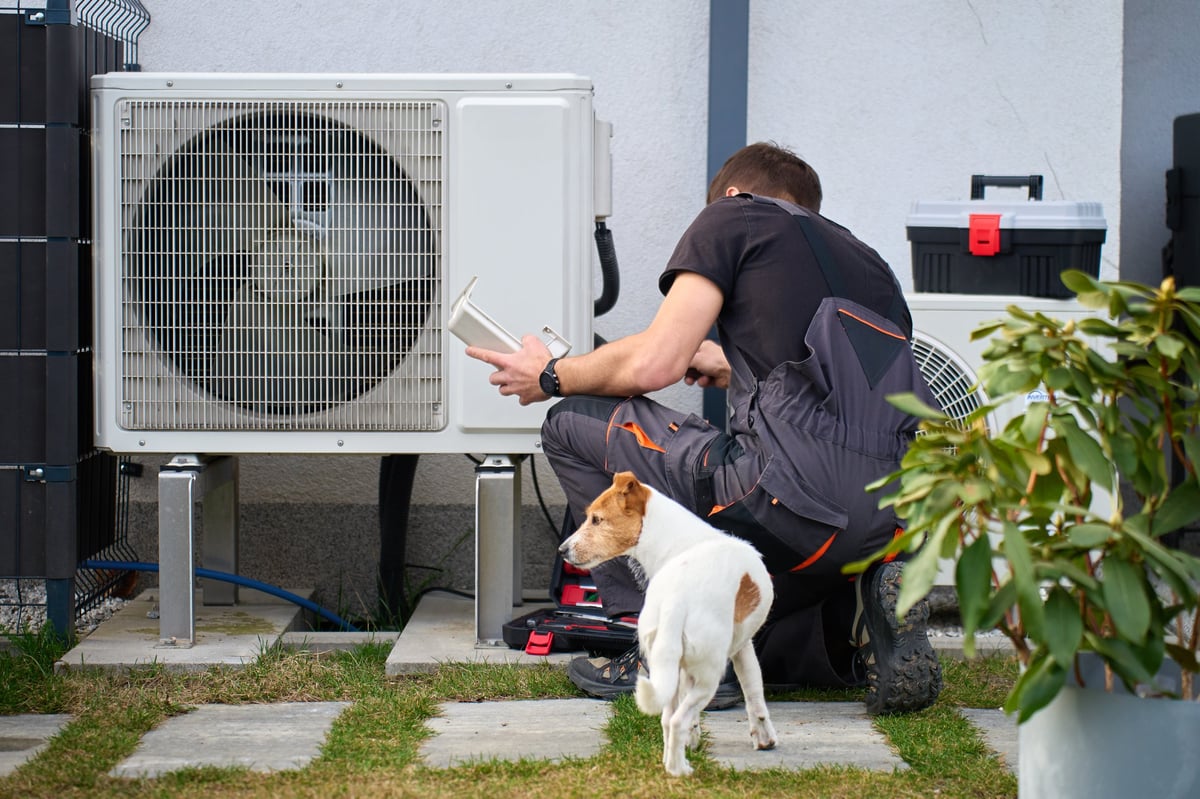
A complete guide to preparing your air conditioning system for the brutal Texas summer heat. From DIY maintenance and energy-saving strategies to knowing when it's time for a replacement — everything Magnolia homeowners need to stay cool without breaking the bank.
Quick Answer
In Texas, your air conditioner is the hardest-working appliance in your home. A well-maintained system should be checked twice a year — once in spring before the summer heat hits, and once in fall before winter. The most important things you can do right now are change your air filter, clean the condenser coils, check your refrigerant levels, and clear debris from around the outdoor unit. Professional maintenance costs $120–$250 and can prevent $2,000+ emergency repairs when it's 102°F outside.
Let's be honest about what we're up against here in Magnolia and throughout Montgomery County. From May through September, we regularly see temperatures above 95°F — and it's not unusual to hit 100°F or higher for weeks at a time. The humidity makes it feel even worse. Your air conditioner isn't just a luxury; it's essential. And when it fails during a heat wave, it's not just uncomfortable — it can be dangerous, especially for elderly family members, young children, and anyone with respiratory conditions.
Here's what most homeowners don't realize: your AC system was designed to maintain a temperature differential of about 20°F from the outside air. When it's 100°F outside, your system is working to keep it at 80°F or below. That's already running at its design limit. If the system is dirty, low on refrigerant, or has restricted airflow, it simply can't keep up. The result? A 78°F house that feels like 85°F because of humidity, energy bills that spike to $400+, and a compressor that's working so hard it's shortening its own lifespan.
I've been on service calls where homeowners in The Woodlands and Tomball were running their AC at 68°F, wondering why the system froze up. Or why their electric bill was $600 in August. The answer almost always comes down to maintenance — or the lack of it. A neglected AC system costs you money every single month, whether you see it on your electric bill or in the shortened lifespan of your equipment.
Before we get into what a professional should handle, let's cover what you can do yourself. These five tasks take less than an hour combined and can make a real difference in how your system performs.
This is the single most important thing you can do — and the one most people ignore. A clogged filter restricts airflow, which makes your system work harder, raises your energy bill, reduces cooling performance, and can cause the evaporator coil to freeze into a block of ice. In Texas summer conditions, we recommend checking your filter every 30 days and replacing it if it's visibly dirty.
Which filter should you use? Don't grab the cheapest fiberglass filter at the hardware store — those only catch large particles and do almost nothing for air quality. But also don't go for the highest MERV rating you can find. Filters rated MERV 13+ are so dense they can restrict airflow in residential systems not designed for them. We recommend MERV 8 to MERV 11 pleated filters. They catch pollen, dust mites, and mold spores without choking your system. Expect to spend $8–$15 per filter. Buy a six-pack and keep them in the garage so you never have an excuse to skip a change.
Walk outside and look at your condenser — that's the big metal box with a fan on top, sitting on a concrete pad next to your house. Is there grass growing up against it? Leaves piled around the bottom? A bush that's grown over it? Pollen and cottonwood fuzz caked onto the fins? All of this restricts airflow across the condenser coils, which is how the system rejects the heat it pulls from your house. Poor airflow = poor cooling = higher bills.
Give your condenser at least 2 feet of clearance on all sides. Trim back bushes, pull weeds, and use a leaf blower to clear loose debris. For the fins (the thin metal grille around the sides), use a garden hose with a spray nozzle — NOT a pressure washer, which will bend the fins flat and make things worse. Spray from the inside out if you can, or from top to bottom, to push dirt out rather than deeper in. Do this every spring, and again mid-summer if you have lots of trees or cottonwood nearby.
Your air conditioner doesn't just cool the air — it dehumidifies it. All that moisture has to go somewhere, and it drains through a PVC pipe (usually ¾") that runs from your indoor air handler to a floor drain, sink, or outside. In the warm, dark, wet environment of that pipe, algae and mold love to grow. When the line clogs, water backs up into the drain pan, and eventually overflows — into your ceiling, your walls, or your closet. We've repaired water damage from clogged drain lines that cost thousands of dollars.
Prevention is simple. Find the drain line (it's usually a white PVC pipe coming off the indoor unit) and pour 1 cup of white vinegar or a commercial drain line treatment down it every 2–3 months during cooling season. If you have a wet/dry vacuum, you can also suction the end of the line from outside to clear any blockage. If your system has a float switch (a safety device that shuts off the AC if the drain pan fills), test it by carefully lifting the float — the system should shut off.
Before summer starts, replace your thermostat batteries if it uses them. A dead thermostat battery means no cooling — a very preventable emergency. If you have a programmable thermostat, now's the time to set your summer schedule. We recommend 78°F when you're home and awake, 82–84°F when you're away at work, and 76–78°F for sleeping. Every degree you raise the thermostat saves about 3% on your cooling bill. That's $15–$25 per month for a typical Magnolia home.
If you don't already have a smart thermostat, seriously consider one. Models like the ecobee SmartThermostat (our top pick for Texas homes) or the Nest Learning Thermostat cost $150–$250 and typically pay for themselves in the first year through energy savings. They learn your patterns, adjust automatically when you leave, and can be controlled from your phone. Some utility companies in the Houston area offer rebates that cover part of the cost.
This sounds simple, but it's surprisingly effective. When your AC kicks on, stand near the indoor unit and listen. A healthy system makes a smooth, steady hum from the blower motor and a soft whoosh of air. Problems have distinct sounds: a screech or squeal means a failing blower motor bearing. A rhythmic thump could be a loose or unbalanced blower wheel. Rattling might be a loose panel or debris in the ductwork. A hissing sound near the indoor coil could indicate a refrigerant leak. If you hear any of these, call a professional — catching problems early is almost always cheaper than waiting for a full breakdown.
A professional HVAC tune-up in the Magnolia area typically costs $120–$250. Some companies advertise $49 or $79 "specials" — be skeptical. Those are usually loss leaders designed to get a technician in your door so they can sell you expensive repairs or a new system. A legitimate, thorough maintenance visit should take 60–90 minutes and include everything below.
| Service | Why It Matters | DIY or Pro? |
|---|---|---|
| Check refrigerant charge | Low refrigerant reduces efficiency by 20–30% and can damage the compressor | PRO ONLY |
| Clean evaporator & condenser coils | Dirty coils reduce heat transfer and can increase energy use by 30% | HYBRID |
| Check electrical connections & tighten | Loose connections cause arcing, component failure, and fire risk | PRO ONLY |
| Test capacitors and contactors | Failed capacitors are the #1 cause of AC not starting on a hot day | PRO ONLY |
| Inspect & adjust blower motor | Improper blower speed wastes energy and reduces comfort | PRO ONLY |
| Calibrate thermostat | A thermostat reading 3° off can waste $100+/year | DIY |
| Inspect ductwork for leaks | Typical homes lose 20–30% of conditioned air through duct leaks | PRO ONLY |
| Check condensate drain & safety switch | Prevents water damage — one of the most expensive home repairs | DIY |
Everyone wants lower energy bills, but there's a lot of bad advice out there. Let's separate what works from what's a waste of money.
Ceiling fans don't cool rooms — they cool people through the wind chill effect. Running a ceiling fan in an empty room wastes electricity. When you're in a room, run the fan counterclockwise in summer (pushing air down) and set your thermostat 3–4°F higher. You'll feel just as comfortable while saving significantly on cooling costs. When you leave the room, turn the fan off. This alone can save $10–$20 per month in a Magnolia home with multiple ceiling fans.
Windows — especially south-facing and west-facing ones — are the biggest source of heat gain in your home. Solar heat coming through a single large window can add as much heat as a space heater running on high. The fix is simple: close blinds, curtains, or shades during the day on windows that get direct sun. Cellular (honeycomb) shades with a reflective backing are the most effective. If you have windows where you want to maintain a view, install a reflective window film — it blocks 50–70% of solar heat while remaining mostly transparent. For a typical home with 8–10 windows, expect to pay $7–$12 per square foot for professionally installed film, or $3–$5 per square foot for DIY kits.
This is one of the most persistent myths in home energy savings. Closing vents in unused rooms doesn't save money — it can actually increase your bills and damage your system. Your AC's blower is designed to move a specific amount of air. When you close vents, you increase static pressure in the ductwork, which makes the blower work harder (using more electricity) while moving less air. This can also cause the evaporator coil to get too cold and freeze up. If you genuinely don't need to cool certain rooms, the right solution is a zoning system with motorized dampers — but that's a $2,000–$5,000 upgrade. For most homes, leave the vents open and use a programmable thermostat to manage overall temperature.
In a Texas attic, temperatures can reach 140°F+ on a summer afternoon. That heat radiates down through your ceiling and into your living space, making your AC work much harder. Most homes in Magnolia and Montgomery County built before 2010 have R-19 to R-30 insulation in the attic — far below the DOE's recommended R-49 to R-60 for our climate zone. Adding blown-in cellulose or fiberglass insulation to reach R-49 can reduce your cooling costs by 15–25%, which translates to $200–$500 per year for a typical home. The cost: $1,500–$3,000 for a professional install. It pays for itself in 3–6 years and improves comfort immediately.
Also worth checking: your attic ventilation. Ridge vents, soffit vents, and powered attic fans (properly installed and thermostatically controlled) keep attic temperatures closer to the outdoor temperature, which reduces the heat load on your ceiling. A well-ventilated attic can be 20–30°F cooler than a poorly ventilated one — that's a huge difference in how hard your AC has to work.
This is the question every homeowner dreads. Your AC is on its last legs, you've had it repaired twice in the last three years, and the technician says it needs another $1,800 repair. Do you fix it again or bite the bullet on a $7,000–$14,000 replacement? Here's a practical framework.
Multiply the age of your system by the cost of the repair. If the result is over $5,000, replacement is usually the smarter financial move. Example: your AC is 12 years old and needs a $500 repair. 12 × $500 = $6,000 → replacement is worth considering. If it's 8 years old and needs a $400 repair: 8 × $400 = $3,200 → repair makes sense. This isn't a hard rule, but it's a useful starting point for the conversation.
Let's be transparent about pricing. These are real numbers based on what we see in Montgomery County.
| System Type | SEER Rating | Typical Cost (Installed) | Best For |
|---|---|---|---|
| Basic Single-Stage | 14–16 SEER | $7,000–$9,500 | Budget-conscious replacement, rental properties |
| Mid-Range Single-Stage | 16–18 SEER | $9,000–$12,000 | Most Magnolia homeowners — best value |
| Two-Stage System | 17–20 SEER | $11,000–$15,000 | Better humidity control, quieter operation |
| Variable-Speed (Inverter) | 18–24+ SEER | $14,000–$20,000 | Ultimate comfort & efficiency, large homes |
| Full System + Ductwork | varies | Add $4,000–$8,000 | Older homes with leaky or undersized ducts |
Prices reflect 2026 installed costs for the Magnolia and Montgomery County market. Includes equipment, labor, refrigerant lines, electrical connections, condensate drain, permit, and startup. Prices vary based on home size, ductwork condition, and equipment brand (Trane, Carrier, Lennox, Goodman, etc.). Always get at least three quotes.
I see this all the time: someone comes home to a hot house, sets the thermostat to 65°F "to cool it down faster," then gets cold and turns the whole system off. AC systems don't cool faster when set lower — they cool at the same rate regardless of the setpoint. Setting it to 65°F just means the system runs longer, overshoots, wastes energy, and creates temperature swings that are uncomfortable and inefficient. Pick a temperature and leave it alone, or use a programmable schedule.
Bigger is not better. An oversized AC cools the house so quickly that it doesn't run long enough to dehumidify the air. You end up with a cold, clammy house — 72°F but feeling like 78°F because of the humidity. Plus, the constant short-cycling (turning on and off) wears out the compressor faster and uses more electricity. A proper Manual J load calculation determines the right size for your specific home, accounting for square footage, window area, insulation, ceiling height, and orientation. Anyone who sizes your system based on square footage alone ("one ton per 500 sq ft") is guessing — and you'll pay for that guess.
Installing a new, high-efficiency AC onto old, leaky ductwork is like putting a brand-new engine in a car with flat tires. Leaky ducts can lose 20–30% of your conditioned air into the attic or crawlspace. If your ducts are over 20 years old, poorly sealed, or crushed in places, replace them when you replace the system. Yes, it adds $4,000–$8,000 to the project — but it also means your new system will actually deliver the efficiency you paid for. We've tested homes where the ducts were losing 35% of the conditioned air. A SEER 20 system with leaky ducts performs worse than a SEER 14 system with sealed ducts.
This is like never changing the oil in your car because it's running fine — you're borrowing time, and eventually you'll pay for it. A $200 annual maintenance visit catches small problems before they become big ones. A failing capacitor ($20 part, $200 service call) left unchecked can take out the compressor ($3,000+ repair). A slow refrigerant leak ($300 to fix) left unchecked leads to a frozen coil and a dead compressor. The math is simple: one major repair prevention pays for 10+ years of annual maintenance.
In Texas, we seal our homes tight and run the AC for 8 months of the year. That means indoor air quality matters — a lot. A good air filter (MERV 8–11) is the minimum. If anyone in your home has allergies or asthma, consider adding a whole-home air purifier (like the AprilAire 5000 or a UV light system in the ductwork) and a whole-home dehumidifier. Managing humidity independently from temperature means you can set your thermostat higher (saving energy) while actually feeling more comfortable. Dry 78°F feels better than humid 72°F.
| Task | When | Who |
|---|---|---|
| Replace air filter | Every 30 days during cooling season | Homeowner |
| Clean condenser coils & fins | April, then July if needed | Homeowner |
| Clear debris around outdoor unit | Monthly during growing season | Homeowner |
| Flush condensate drain line | Every 2–3 months | Homeowner |
| Professional HVAC tune-up | April–May (before summer) | HVAC Technician |
| Check attic insulation depth | Once, then every 5 years | Homeowner or Pro |
| Check ductwork for visible leaks | Annually (look in attic) | Homeowner or Pro |
| Change thermostat batteries | April | Homeowner |
| Program summer thermostat schedule | May | Homeowner |
| Close blinds/curtains on sunny windows | Daily during summer | Homeowner |
| Check & seal window/door weatherstripping | April | Homeowner |
Your air conditioner is a $7,000–$14,000 piece of equipment that runs for 2,000+ hours every summer in Texas. A little maintenance goes a long way. Change your filter. Keep the outdoor unit clear. Get an annual professional tune-up. Pay attention to how your system sounds and how your home feels. Address small problems before they become breakdowns on a 100°F Saturday afternoon when every HVAC company in Montgomery County is booked solid for three days.
The Texas summer is coming — it does every year. A few hours of maintenance in April and May can save you thousands of dollars and a whole lot of misery in July and August. Stay cool out there.
Whether you need a reliable HVAC technician recommendation, are planning a renovation that involves AC work, or want a whole-home energy assessment, Burton Residential Services has been helping Magnolia-area families stay comfortable for years. We serve Magnolia, The Woodlands, Tomball, Montgomery, Conroe, Pinehurst, and throughout Montgomery County.
Licensed & Insured • Serving Greater North Houston • Family-Owned